Kenyalogy
   
  Home  |  Site map  |  Contact  |  Links  |  Recommend

 AFRICAN SAFARI
    Plan your safari here
 THE KENYALOGY
 GUIDE
    Useful facts
    Geography
    History
    Climate and vegetation
    Economy
    Population and culture
    Parks and reserves
  Wildlife
 MAPS
    Kenya maps
    City maps
    Africa maps
    Antique maps
 IMAGES
    Photo gallery
    Art gallery
 HAVE YOUR SAY
    The Waterhole (forum)
 STUFF
    The Kenyalogy Guide
    in PDF
    Books and more
    Wallpapers
    GPS waypoints
  You are here: Home > Wildlife > Mammals > African buffalo
 
WILDLIFE: MAMMALS: AFRICAN BUFFALO
 

Geographical distribution
Class: Mammals
Order: Artiodactyls
Family: Bovids
Subfamily: Bovines
Genus and species: Syncerus
   caffer

Common name:
   English: African buffalo
   Swahili: Nyati, mbogo
African buffalo


Identification

    Body: massive and heavily built, ox-like. Blackish-brown in colour, with sparse hair. Conversely, calves show abundant hair and lighter in colour, reddish brown, that does not darken until the third year. Thick and strong legs. Tail long with a terminal tuft. Height at shoulder: 1.5 m. Length: 1.8-2.5 m. Tail: 60-70 cm. Cows smaller than bulls. Weight: males 500-800 kg, females 550 kg.

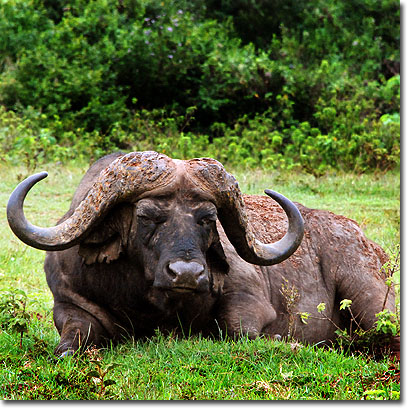
    Head: muzzle large and broad, naked and moist, with large nasal fossae in the tip. Small eyes and big ears, perpendicular to the body. Neck short and strong. Horns greatly developed and thick, glued at the root in a massive frontal base, curved outwards and downwards, with the tips turned upwards and inwards. Present in both sexes, though in females they are less developed and the base is lighter.


Distribution and ecology

    Common and widely distributed. Inhabits a great variety of habitats, from dense forest to grasslands. In the mountains it can be found up to 4000 m. It is frequent in swampy areas. Conversely, it avoids extremely dry regions with no water sources.

 
Food

    Grazes all kinds of grass, even the coarsest. Also browses, specially in forest areas where it eats leaves, sprouts, and stems, mainly in the dry season. It is very voracious and needs to drink up to 30 liters of water a day, reason why its distribution is restricted to wet regions or with nearby waterholes. It is a usual visitor of salt licks.

 
Behaviour

    Gregarious, it often gathers in large herds. Males are either solitary or associate in small groups of 5 to 10 individuals, same as wounded animals. In forest areas, buffalos are found in reduced cores, from 3-4 up to 10 head. On the opposite side, in open habitats great herds of hundreds can be easily seen, sometimes reaching 2,000. The greatest groups are formed during the rains, whereas in the dry season they break up into smaller herds consisting of several related females and their calves, which is the minimal social unit. The gregarious instinct of buffalos is highly cooperative in nature, to such an extent that if one herd crosses a solitary bull's territory, the owner will take control of the group and will guide it through its lands up to the boundary, where it will hand the baton to the neighbouring territorial bull.

    Buffalo herd licking salt of the ground at The Ark, Aberdares national park Herds are ruled by dominance relationships established according to fighting abilities. The great herd is dominated by an adult bull, but the one who leads the group when moving is generally an old cow. Females climb in the rank after maternity. When moving, dominant individuals march in the first place and in the central core, accessing to the best food and achieving better protection against predators. When they are 3 years old, young males leave their mother's group to associate with equals, always within the herd, but they have to wait till they are 7 or 8 years old to exercise their fighting abilities and gain the right to mate.

    Buffalos are equally diurnal and nocturnal, though outside the protected areas they tend to be more active by night. During the day they hide in the bush seeking protection from sunlight, often near a water source. In the evening and at night they come out to feed and drink, returning afterwards to ruminate under cover. When the herd is grazing, the explorers remain alert to warn the group of any possible danger. It is a sedentary animal, occupying wide territories on a permanent basis. It frequently visits the mud ponds, where it rolls to relief its body from the parasites' bites. The mud bath serves as a barrier against horseflies and other insects, and at the same time traps the parasites when it dries up. Later, the animal gets rid of them by rubbing the dry mud of his body against a tree trunk.

    Buffalo calf, 3 months and a half Its sight and hearing are poor, so buffalos trust in their very sensitive smell, capable of detecting a predator 250 m away. In general they are silent, except in the mating season, at the end of the long rains. In these days, grunts and bellows are the usual music in the herd and males can be seen fighting fiercely, pressing their horn bases in a wrestling competition. In spite of all, the African buffalo is actually a placid animal, save when it is injured or at bay. In such cases it can show a very aggressive behaviour.

    Buffalos have two permanent partners, cattle egrets and oxpeckers. The former eat insects removed from the ground and grass by the bovine's motion. In exchange, these birds warn buffalos of any possible threat. On the other hand, oxpeckers hang from the buffalo's body and feed on ticks and fly larvae that hide amongst the hair and in the open wounds. In addition, these birds complement their diet with scabs and pieces of dry flesh and skin, so they perform a very beneficial task of wound cleansing.

    The major buffalo's predator is the lion, that preferentially attacks the small bachelor groups, since the great herds offer a high level of protection to their members. Hyenas prey on calves and on sick or weak animals, and crocodiles can grab them while fording a river. Buffalos have been seriously beaten along history by rinderpest epidemics such as those occurred in the 1890's. Still, their population is today plentiful, and in certain locations it is even more abundant than it was ever before. Its longevity is 16-20 years.


Reproduction

    Most births take place during the long rains. Cows have their first calf when they are 5 years old and from then on they conceive every other year. Gestation lasts 11-11.5 months. The cow delivers among the resting herd or otherwise seeks shelter under cover. The only calf remains concealed until it is able to stand up and walk to follow its mother back to the herd.

 
Related species

    The buffalo's taxonomy has been controverted, since great variations in size, colour and horn shape can be found throughout Africa. Most authors agree in enclosing all African buffalos in a single species, Syncerus caffer, composed of animals probably derived from two different types that have interbred to different extents. These two types are considered different subspecies, the Cape buffalo, S. c. caffer, and the dwarf forest buffalo or red buffalo, S. c. nanus, not found in Kenya. Between both there is a wide range of intermediate morphologies.
Top
 
Search Kenyalogy:  

 
    Wildlife
      Taxonomy
      Mammals
       African buffalo
      Birds

Home | Site map | Contact
Recommend Kenyalogy |
Advertising | Privacy policy
© Kenyalogy 2000-2006
